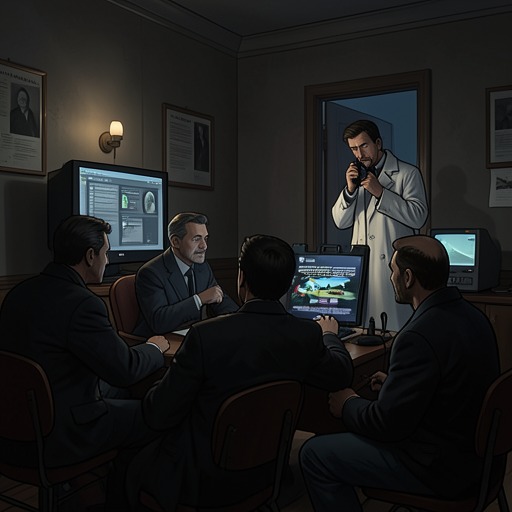
William Pickering
Deception PointWilliam Pickering is the director of the National Reconnaissance Office, a quiet strategist whose creed of discovering truth and acting on it is tested by the deception he secretly engineers. To Rachel Sexton he first appears as a blunt but dependable superior; the revelation that he is the controller behind the meteorite plot recasts that steadiness as the discipline of a man willing to sacrifice individuals for what he considers the national good.
Identity and Institutional Bearing
Pickering is physically diminutive, with pale skin, a bald head, hazel eyes, and a face so unremarkable that it is easily forgotten. Yet his employees regard him as a commanding presence. His subdued manner, unadorned philosophies, and quiet diligence have made him legendary at the National Reconnaissance Office. He wears plain black suits and has consequently acquired the nickname the Quaker. The contrast between his modest appearance and his authority is central to his effectiveness: he does not need charisma or spectacle to run his world with clarity and efficiency.
His defining maxim is to find the truth and act on it. That principle sounds like a pledge of intellectual honesty, and much of Pickering’s early conduct appears to support it. He is a brilliant strategist and a model of efficiency, but the story eventually makes the maxim morally unstable: he does act on what he believes to be true about political danger, yet he also conceals the means by which he tries to control that danger. His authority gives him both the capacity to intervene and the means to keep his intervention hidden.
Rachel Sexton’s Superior and Adviser
Rachel has always liked Pickering, in part because he is the antithesis of her father, Sedgewick Sexton. Where her father is charismatic and drawn to the spotlight, Pickering is physically unimposing, self-effacing, and devoted to duty. Rachel’s regard for him rests not just on his position but on this apparent difference in character: Pickering seems to embody service without self-promotion.
When Zachary Herney asks to meet Rachel, Pickering sees the political danger immediately. Her father is challenging the president in the polls, and the president’s private approach to the opponent’s daughter could look improper. Pickering objects as well to being denied an explanation for the request: if the meeting concerns White House work, he argues, there are qualified staff available; if it does not, the president should not summon an National Reconnaissance Office asset while withholding the purpose. He warns Rachel that unresolved personal issues with her father could cloud her judgment in dealings with the president. Even so, he advises her to meet Herney, make no commitments, and report back. If the president is using political hardball, Pickering promises to withdraw her from the situation. His counsel combines caution with a willingness to protect a subordinate, and it helps establish why Rachel trusts him.
That relationship is later placed under direct pressure by the very secrecy Pickering had challenged in the president’s request. While Rachel and two civilian scientists are at sea, she departs from an earlier plan to maintain radio silence until reaching Bolling Air Force Base and calls Pickering’s secure cellular phone. She has information she believes he needs at once. Pickering, in turn, arranges a private meeting with a woman whose identity he does not disclose in their conversation, expecting it to reveal much. The exchange shows that he is still treated as Rachel’s trusted contact even as the plot’s hidden control begins to close around her.
The Controller and the Meteorite Deception
Pickering’s concealed role emerges on the Goya when a helicopter lands on its deck and a plain-looking man in a black coat and tie steps out. Rachel recognizes him as Pickering; the shock comes not from a changed appearance but from the sudden collapse of the distinction between her superior and the unseen controller. He tells her that her father has accepted payoffs from private space companies and plans to dismantle NASA and open space to private enterprise. Pickering presents stopping him as a matter of national security.
The disclosure turns the meteorite hoax into an institutional operation rather than an isolated scientific fraud. Pickering explains that he and a quiet team of National Reconnaissance Office science advisers used their knowledge of the Mariana’s geology to help save NASA. They converted a Mariana rock into a convincing meteorite, giving it a fusion crust with an ECE slush-hydrogen engine. A small payload submarine carried the charred rock beneath the Milne Ice Shelf and inserted it upward into the ice. Once the shaft refroze, the placement made the rock appear to have been there for more than three hundred years. The operation depended on controlled access to specialized technology, expertise, and secrecy; the plan’s elaborate construction also left it vulnerable to an unexpected detail. Bioluminescent plankton shattered the illusion.
The explanation makes Pickering’s strategic intelligence inseparable from his deception. He is not merely informed about the false discovery: he directed the clandestine effort that fabricated its physical evidence. The same efficiency and operational clarity that distinguish his leadership have enabled him to build a lie persuasive enough to influence public and political judgment. His stated national-security purpose may explain the operation, but it does not undo the breach of trust involved in manufacturing evidence.
Rachel, the Mission, and the Cost of His Logic
Even after revealing the scheme, Pickering continues to frame Rachel’s actions as a threat to the country. He tells her that she has made an enormous mistake by sending data off the ship and insists that the situation is too complex for her to understand. The exchange reverses their earlier working relationship: the superior who had urged her to guard against political manipulation now uses his authority to discredit her judgment and contain the consequences of his own operation. Rachel’s evidence has become dangerous precisely because it can expose the hidden construction Pickering believes must remain protected.
His logic is finally expressed as a calculus of casualties. Moving toward two prisoners, Pickering feels strangely detached and is surprised that the action is not harder for him. He invokes the deaths of those who defend the nation, including Diana Pickering, and argues that war involves casualties. He then appeals to the principle Iactura paucourm serva multos: sacrificing the few to save the many. This is not an abstract slogan detached from his conduct. It names the moral arithmetic by which he has justified deceiving the public, endangering Rachel and the scientists, and treating their exposure of the truth as a national-security risk.
The final image of Pickering is one of physical and ideological collapse. A geyser erupts from the ocean vortex beside the Goya, the funnel expands, and the ship’s stern swings toward the widening cavity. Pickering loses his balance and falls to his knees, gazing into the abyss. The scene leaves his fate unstated, but it gives his defining posture a stark counter-image: the strategist who had seemed to survey events from the top of the world is brought down before a force no plan can command.
Narrative Role and Significance
Pickering’s plot arc depends on a reversal in what his restraint means. At first, plain suits, quiet diligence, and suspicion of political impropriety mark him as an antidote to self-serving spectacle. His maxim about truth appears to anchor that character. The later revelation does not erase those traits; it shows how the same clarity, discipline, and patriotism can serve a secret operation when a leader decides that its ends justify its methods.
As Rachel’s superior, Pickering possesses institutional authority; as the meteorite operation’s controller, he also exercises power outside the account available to her and the public. That gap between formal responsibility and concealed action drives the betrayal. His conviction that he is protecting NASA and the country is genuine within his stated argument, but the deception he constructs undermines the trust on which both scientific claims and public decisions depend. The Quaker’s defining contradiction is therefore not simply that a quiet man hides a plot. It is that a commitment to acting on truth becomes, in his hands, a warrant to manufacture and conceal evidence in the name of a larger good.